
Making Sense of Iran Through Five Books
Premanand Mishra
Since the 1979 Iranian or Islamic revolution, its contested history has been shaped by the production of narratives, propaganda and battle of patriarchy. The view from the West on Iran has largely been shaped by an Orientalist lens: oil, sanctions, proxies, nuclear aspirations and the despotic rule of Ayatollahs. For the World, Iran has been a place of unintended consequences. Energy sources, nuclear ambitions and political power of Shia Islam. But Iran, for many Iranians and Shiites across the world, is the prototype of modern Karbala, the act of pure resistance and living reality of battle against all oppressions. But there are many Iranians who believe the regime that has ruled since 1979 has been a crossover patriarchy from the despotic Shah to theocracy. The battle of patriarchy, where women have been on the margins and struggle to breathe. But beyond the clash of narratives, Iran is also the land of Rumi, Khayyam, and great filmmakers like Majid Majidi and Jafar Panahi. Iran is the land of many paradoxes and unintended consequences.
The cloud of Ignorance
The US perception of Iran has been shrouded in persistent ignorance. Going back to the early period of the Islamic revolution in 1979, this ignorance, unruffled with the events of the famous incident of the notorious hostage crisis during 1979-81, still haunts US relations with Iran. This monolithic perception about Iran manifests Americans' notion about revolution and its bad sense of history beyond its conventional understanding and therefore the idea that Islam can function as a revolutionary ideology is still a chimera manifesting deeply in the Iranian societies and the battle of perceptions becomes the chief source of American ignorance. Iran and the modern West, led by the US, have suffered from the analogy of the axis of resistance and the axis of evil. The killing of Ayatollah Ali Khamenei, the most significant figure in Iran after Ayatollah Khomeini, the face of the 1979 Iranian revolution, might forever change the map of Iran's polity and its position in the world.
The recent writings explain Iran and its current standing. These recommendations are significant for understanding everything that matters: a brief history of Iran, connecting threads between pragmatism and ideology, and perspectives on political-cultural history and the making of its grand strategy. The world, however, needs to know more about Iran; its society, culture, politics, architecture, great literary tradition, as well as its theocratic nature, expansionist politics across the Middle East, arming proxies, nuclear ambitions and regional hegemony. The following books will help us make sense of modern Iran and its society.
1. Vali Nasr, Iran’s Grand Strategy: A Political History (Princeton, NJ: Princeton University Press, 2025).

Vali Nasr brings a compelling political history of Iran’s grand strategy. He moves forward from the dominant narrative on Iran and often brings ‘ideology versus realism’ as a systematic scholarly view on Iran particularly in the Western academia. Nasr’s fundamental hypothesis is about Iran’s strategic culture in confronting the security dilemma, power structure from an internal-external lens and the continuation of revolutionary ideology. He poignantly essays the strategic behaviour of Iran in insulating it from Western coercions and the decades of the sanction regime. He argues that Iran has developed an arc of resisting the asymmetric power that it has with the West by employing its proxies and nuclear pursuit as deterrence.
Nasr’s centers’ his argument on Iran’s strategy of Isteqlal (sovereignty or freedom), an act of psychological project of self‑reliance experienced since the 1979 revolution and the subsequent War. He builds his argument as a chronology of Iran’s political power structures, tracing successive presidents and their manoeuvres in managing Iran’s external relations, the US factor, and Iran’s strategy toward the larger Middle East. His sources are memoirs and elite power structures, thus dwelling more on the security matrix and is less concerned with movements that have also confronted Iran over the decades, as one finds in other writers such as Hamdi Dabashi. He often brings up the notion of the siege confronting the Iranian regime and its act of resistance, oscillating between religious ideology and prudent pragmatism. Nasr’s work is a must-read for its poignant sketch of Iran’s political and security superstructures, its intellectual sources and the making of its grand strategy.
2. Scott Anderson, King of Kings: The Iranian Revolution – A Story of Hubris, Delusion and Catastrophic Miscalculation (New York: Doubleday/Random House, 2025).
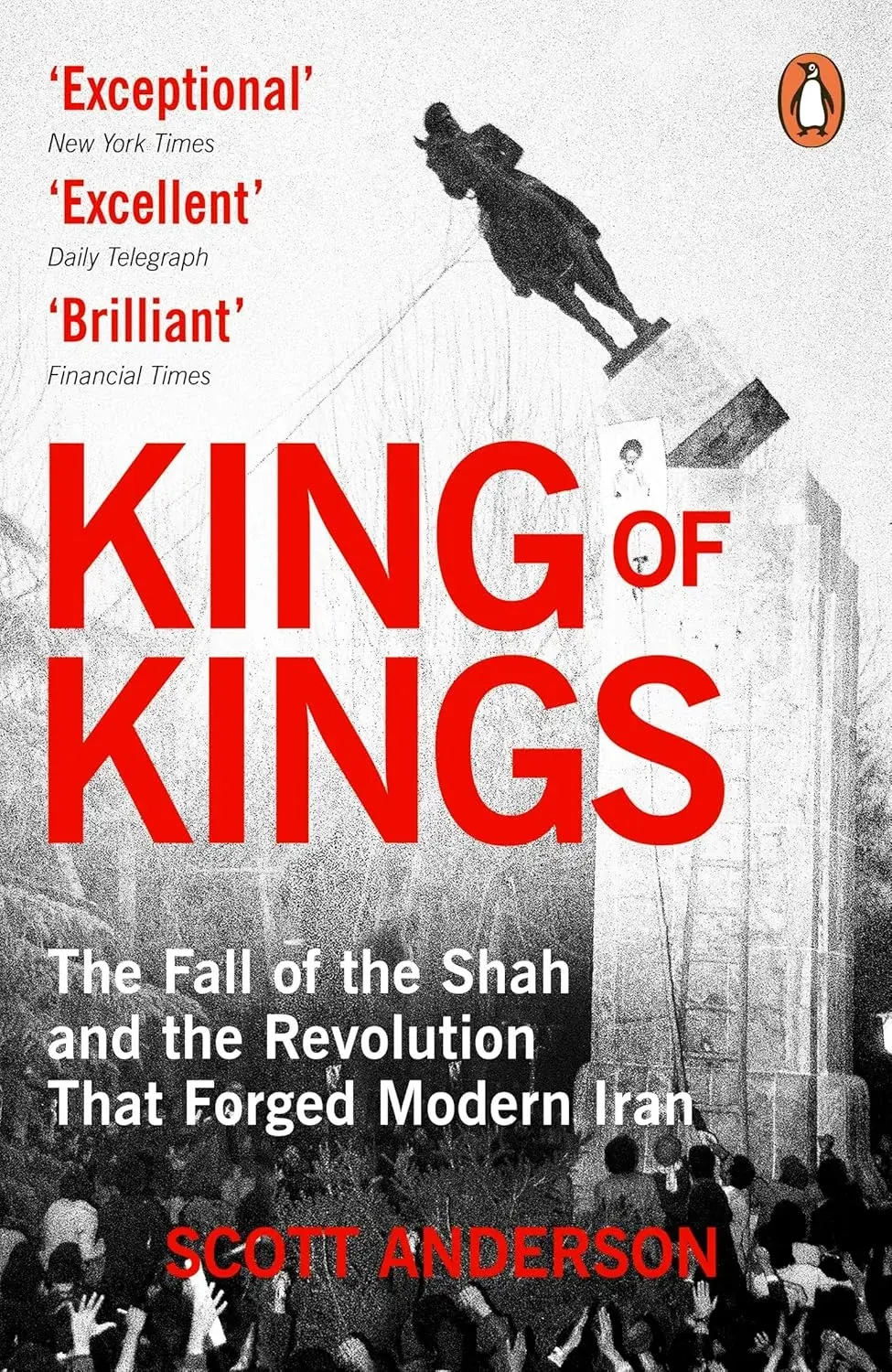
The lens of Scott Anderson is uniquely present in scholarly and imaginative texts—a novelist and a war correspondent who investigated the narrative history of Iran since the 1979 revolution. The author has a reputation of writing popular accounts, Lawrence in Arabia – War, Deceit, Imperial Folly and the Making of the Modern Middle East (2013). His King of Kings is an intersection of politics, diplomacy, and narratives that connect accounts of revolution, the structure of Pahlavi’s rule, and the misadventure of US policies toward Iran. Anderson’s work unpacks the underlying structure of Shah's autocracy and major misgovernance, which have invigorated unsustainable optics in managing socio-economic realities. He further navigates the US policies and their blunders. Anderson’s accomplished work delves deeper into the three critical features that explain Iran before and after the Shah: the hubris of the Shah (ignorance and arrogance), the US's misperceptions of Iran (successive failures), and the reconstruction of Islamic ideology (the making of Khomeini’s Iran).
3 Mehran Kamrava, How Islam Rules in Iran: Theology and Theocracy in the Islamic Republic By (Cambridge: Cambridge University Press, 2024)

Kamrava’s ‘How Islam Rules in Iran’ is a comprehensive and assertive portrayal of Iran since the 1979 revolution. His work delineates the populist internal structures of religious ruling in the making of modern Iran. Kamrava connects the state-society relations and form of governance in Iran, its process, structures and religious legitimacy drawn on a strict Shia interpretation of Islam. He provides an interesting and critical analysis of the jurisprudential debates surrounding Khomeini’s introduction of Velayat-e Faqih, the most comprehensive document and the source of Iran’s governance model since 1979. Velayate-e Faqih resonates the Shia belief in the occultation of its 12th Imam, Mehdi, and the ruling of learned jurists in his absence. Kamrava digs deeper into the structures of Iran’s governance, the role of seminaries, and the narratives built through the churning of practices and beliefs within religious theocracy. Kamrava's work is a must-read for anyone who wants to know the inner Iran, the surrounding noise and the rupture within.
4. Mohsen M. Milani, Iran’s Rise and Rivalry with the US in the Middle East (London: One World Publications, 2025)

Mohsen Milani's work is another credible source for understanding what’s happening in Iran and why. He is a political scientist with extensive experience in understanding Iran, its behaviour, and the crisis in US-Iran relations. Milani’s work posits a comprehensive overview of Iran’s pursuit of regional hegemony despite being under coercive sanctions. Milani’s core argument provides a detailed and measured analysis of Iran's resistance against the US, Israel and Saudi Arabia’s regional power-balancing act. He dwells deeper into Iran’s act of survival through manoeuvring its policies in building an axis of resistance using proxies across the Middle East. His work captures the essence of how the US's inaccuracies in the 2003 invasion of Iraq subsequently helped Iran develop its asymmetric security infrastructure. He methodologically binds the strategic buildup of Iran throughout its modern history, particularly the fate of the Middle East after the 9/11 attacks in the US. He examines Iran’s strategic behaviour through the prism of US-Iran relations. This work provides important detail on how Iran operates through its proxies, its material and ideological support, and the making of Iran’s regional security framework, and its impact on Iran’s domestic upheavals.
5. Arash Azizi, What Iranians Want: Women, Life, Freedom (London: One World Publications, 2025)

Iran’s rich literary tradition also influenced women's writing, including issues of women's struggle within the theocratic state. Since Shirin Ebadi’s win of the Nobel in 2003, the struggle of Iranian women finds a flurry of writing raising women’s issues from Ebadi’s Iran Awakening, Marjane Satrapi’s Persepolis & Embroideries, Prisoner of Tehran by Marina Nemat, Marjan Kamali’s many works and fitting works of Azar Nafisi’s Reading Lolita in Tehran make a catalogue of an extraordinary sense of rich women's writings.
Arash Azizi takes the baton and knits the hollow sense of revolution within, and how it has impacted women over the decades. Under the rubble of US pressure on Iran, making it more conservative, and the patriarchy within that hate women's freedom as enemies of the state. He argues that Iranian women’s struggle is deeper than Mahsa Amini’s case and that it was just a small chapter in Iranian women’s enduring struggle for life, liberty, and the pursuit of happiness. Azizi’s work mirrors the schism within what the Islamic Republic offers and what Iranian’s really want, particularly women. His accounts of Women (feminist movements), Life (security), and freedom (resistance) are an exceptional work. ‘What Iranian’s Want’ deserves to be in every library and in everyone’s hands.
The Uncertain Future
Iran has been the image of many contrasts, where patriarchy dominates with an iron hand. The Mahsa Amini incident, which drew global attention, was not an isolated event. The US- Israel war on Iran has reached an unprecedented crisis. An age of total war, where the world has to suffer and once the dust settles, nobody can comfortably predict the direction and the future of Iran, the Middle East and the World. The Abraham Accords between Israel and a few Arab countries and Israel’s war crimes in Gaza, Palestine have helped Iran's image in the region. The US policy needs a serious change towards the region. Iran would never compromise its sovereignty, as it carries a strong sense of cultural nationalism that helps it to sustain the US pressure. Anything beyond might please Trump’s ego, but ignorance won’t be a comfort.



Comments